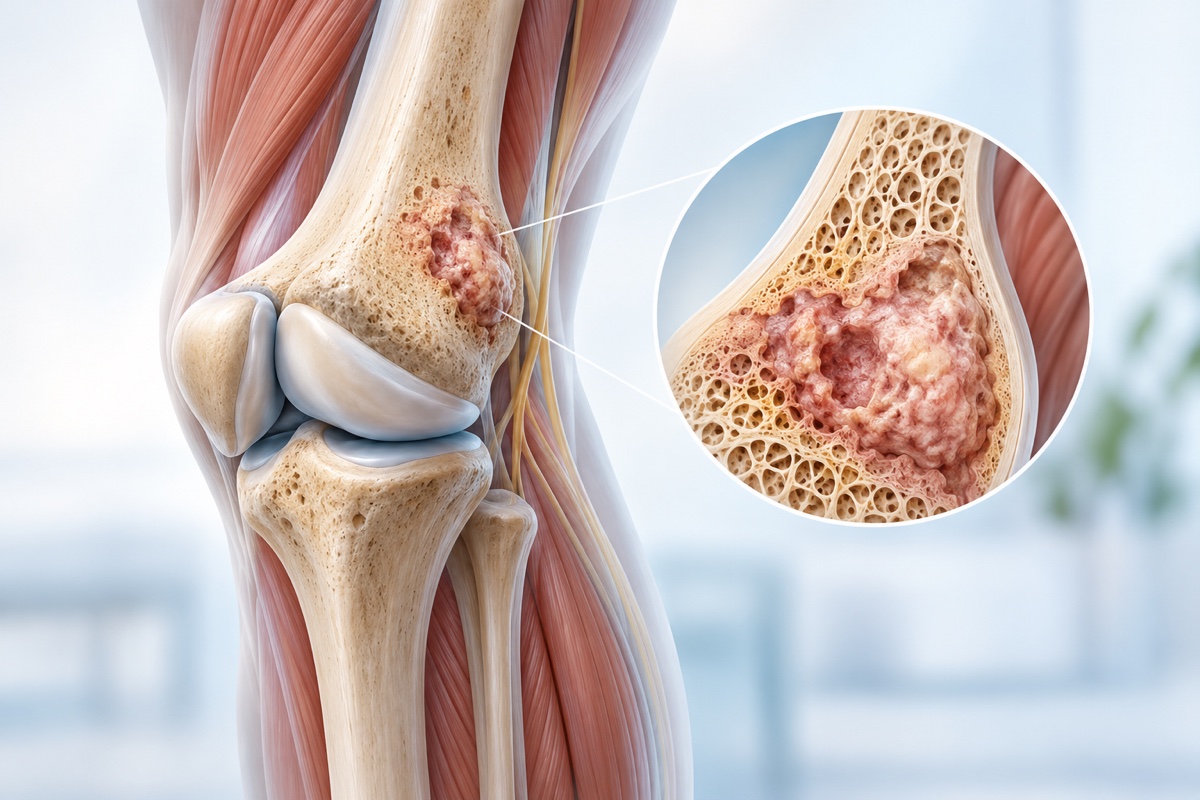
What is bone cancer?
Primary bone cancers are rare malignant tumors arising from bone-forming, cartilage, or other cells in bone. Osteosarcoma often develops near the knee or shoulder in adolescents and young adults but can occur later in life. Ewing sarcoma affects bone or soft tissue, mainly in younger people. Chondrosarcoma arises from cartilage and is more common in adults; chordoma develops along the spine or skull base. These diseases differ from bone metastases, which retain the identity and treatment of the original cancer. Risk factors vary and may include prior radiation, Paget disease of bone, or inherited syndromes, but most patients have no clear cause. Initial imaging and biopsy planning matter because a poorly placed biopsy can interfere with limb-sparing surgery. Care depends on exact pathology, bone and location, tumor size and grade, localized or metastatic status, resectability, molecular biomarkers, age, skeletal maturity, and health.
Signs and symptoms
Persistent pain at the tumor site is a common symptom and may worsen at night or with activity. Swelling, a palpable mass, tenderness, limping, or reduced movement near a joint can develop. A tumor can weaken bone and cause a pathologic fracture after little trauma. Spine or skull-base tumors may produce nerve symptoms, weakness, numbness, headache, or changes in bowel or bladder function. Advanced disease can cause fatigue, weight loss, cough, or shortness of breath, though general symptoms are less specific. Most bone pain and fractures result from injuries, arthritis, osteoporosis, infection, or benign bone lesions rather than cancer. Pain that persists, progresses, wakes someone repeatedly, or occurs with swelling should be assessed. Sudden severe pain, new limb weakness, loss of bladder or bowel control, or breathing difficulty requires urgent clinical evaluation.
Diagnosis and staging
Plain x-rays often provide the first view of a suspicious bone lesion. MRI maps the tumor within bone and nearby soft tissues, while CT adds bone detail and chest CT evaluates the lungs. PET, bone scan, or whole-body imaging may identify other sites depending on subtype. Biopsy is essential and should be planned by the orthopedic oncology or sarcoma team that would perform definitive surgery; the biopsy tract must be placed so it can later be removed. Pathology determines subtype and grade, supported by immunohistochemistry and molecular testing for defining changes such as EWSR1-related fusions in Ewing sarcoma. Staging evaluates local extent, grade, nodes when relevant, and distant spread. Some diseases use localized, metastatic, and recurrent categories. Care depends on subtype, site, grade, stage, biomarkers, age, and overall health.
Established treatment paths
Treatment is specific to histology. Surgery aims to remove the tumor with negative margins while preserving the limb and function when oncologically safe; reconstruction may use implants, grafts, or other techniques. Osteosarcoma usually requires multi-drug chemotherapy before and/or after complete surgical removal. Ewing sarcoma uses systemic combination chemotherapy plus surgery and/or radiation for local control. Conventional chondrosarcoma is treated mainly with surgery because many cases respond poorly to standard chemotherapy and radiation, although approaches differ for rare molecular subtypes and unresectable disease. Chordoma often requires specialized surgery and high-dose radiation techniques. Radiation is also used when tumors cannot be fully removed, for sensitive histologies, or for symptom relief. Targeted therapy has roles in selected tumors, such as certain giant cell tumors of bone, and trials may be appropriate for recurrent disease. Metastases may sometimes be resected or treated with systemic or focused local therapy. Care depends on subtype, site, grade, stage, biomarkers, treatment response, age, and health. Early coordination helps ensure that biopsy, chemotherapy, surgery, radiation, and reconstruction occur in the safest sequence.
Supportive care
Supportive care includes pain treatment, fracture prevention, mobility aids, and coordinated rehabilitation before and after surgery. Physical and occupational therapy help preserve strength, movement, and daily function; prosthetic services support people who need amputation. Teams manage chemotherapy-related nausea, low blood counts, infection risk, heart or kidney effects, and radiation skin or tissue effects. Fertility preservation and school or work planning may be important, especially for adolescents and young adults. Palliative care can assist with symptoms and quality of life alongside treatment. Dental or bone-health review may be needed for selected medicines. Follow-up commonly includes local and chest imaging plus functional assessment. Supplements and medicines should be reviewed for interactions and surgical bleeding risks.
Questions to ask your cancer care team
Use the questions that fit your situation, and add the details that matter most to you.
- Is this a primary bone cancer or cancer that spread to bone?
- What subtype and grade did specialist pathology confirm?
- Was the biopsy path planned for definitive surgery?
- Can surgery preserve the limb and function, and what reconstruction is expected?
- What are the roles of chemotherapy, radiation, targeted therapy, or trials for this subtype?
Clinics for people exploring bone cancer care

Sunridge Medical Center
Sunridge Medical reports treating all advanced cancers. Its published materials specifically name bone cancer care.
Featured placement is separate from an independent ranking or evidence that a clinic is the best fit for a particular patient.Other source-matched clinic profiles
These profiles mention a matching cancer specialty in their published materials. Browse their locations, reported services, and practical details.


Sources
Source information checked: 2026-09-29. The links below identify the public and clinic-provided materials used for this page.
- NCI: Primary Bone Cancer ↗Checked 2026-09-29
- NCI: Bone Cancer—Patient Version ↗Checked 2026-09-29
How Cancer Clinic Finder compiles information · Suggest a factual correction