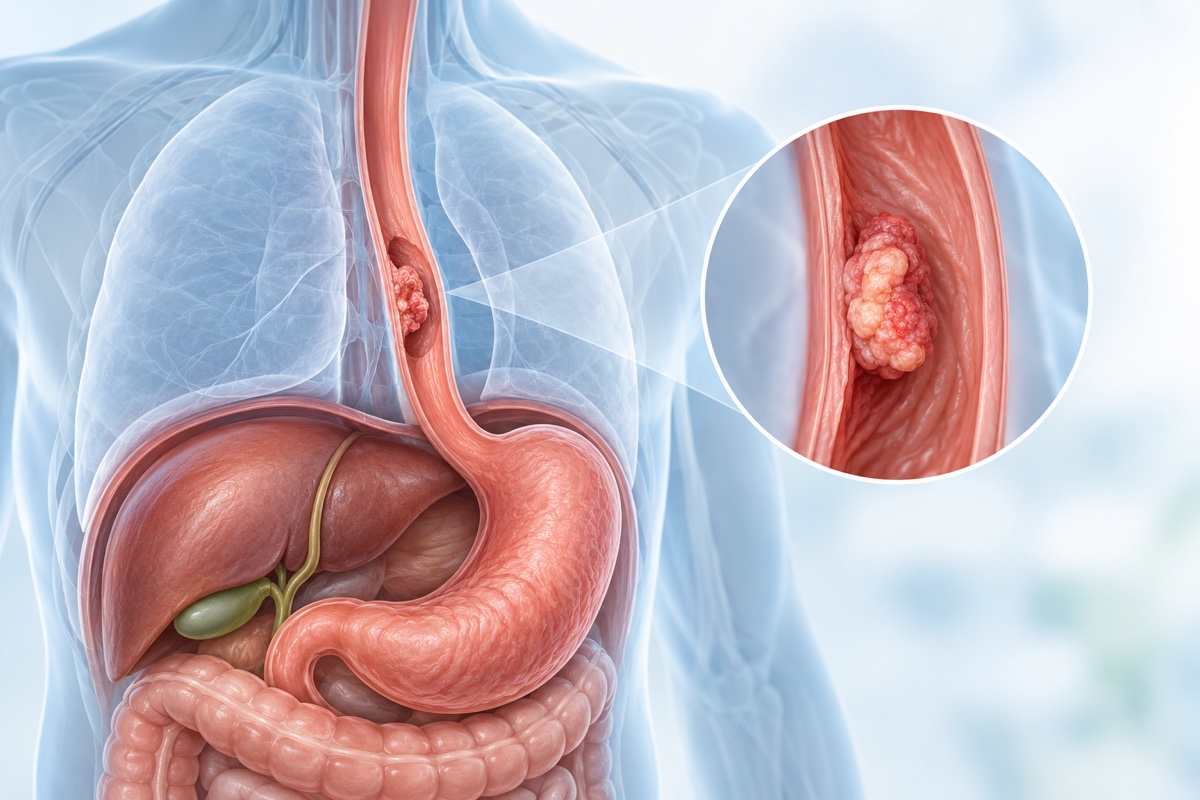
What is esophageal cancer?
The esophagus has several layers, and cancer stage reflects how deeply a tumor grows and whether it reaches lymph nodes or distant organs. Squamous cell carcinoma can arise throughout the esophagus and is associated with tobacco and alcohol exposure among other risks. Adenocarcinoma usually develops in the lower esophagus and is associated with Barrett esophagus, chronic reflux, and obesity, though many affected people lack an obvious cause. Tumors at the gastroesophageal junction require careful classification because treatment can overlap with stomach-cancer pathways. Early disease may be limited to the inner lining and removable endoscopically. Locally advanced cancer often requires coordinated chemotherapy, radiation, and surgery, while metastatic disease is managed primarily with systemic therapy. The tumor’s relationship to the airway, heart, major vessels, and stomach affects whether surgery is feasible. Swallowing and nutrition need early attention because obstruction and treatment can quickly reduce intake and weight.
Signs and symptoms
The most common warning pattern is progressive difficulty swallowing, often beginning with solid foods and later affecting softer food or liquids. Other possible symptoms include pain with swallowing, food sticking or returning, chest or back discomfort, unexplained weight loss, hoarseness, chronic cough, vomiting, blood in vomit, or black stools. Aspiration of food or liquid can cause coughing during meals or recurrent chest infections. Reduced intake can lead to dehydration, weakness, and malnutrition. Sudden inability to swallow liquids, vomiting blood, breathing difficulty, or severe dehydration needs urgent assessment. These symptoms can also be caused by noncancer conditions such as reflux, inflammation, motility disorders, infection, or benign narrowing. Persistent or progressive swallowing trouble requires medical evaluation even when reflux or another common condition seems likely.
Diagnosis and staging
Upper endoscopy visualizes the esophagus and permits biopsy; pathology distinguishes adenocarcinoma, squamous cell carcinoma, and less common tumors. The report may also provide grade and biomarker results. CT of the chest and abdomen evaluates lymph nodes and distant organs. Endoscopic ultrasound helps estimate tumor-wall depth and can sample nearby nodes. PET-CT, bronchoscopy, or laparoscopy may be used in selected cases based on tumor location and planned treatment. TNM staging records invasion depth, regional nodes, and metastases, with stage grouping also influenced by histology and location. Biomarker testing in advanced adenocarcinoma may include HER2, PD-L1, and mismatch-repair or microsatellite-instability status; squamous cancers also use PD-L1 in treatment planning. Nutrition, lung, and heart assessment helps determine fitness for combined therapy and surgery. Care depends on histology, exact location, stage, biomarkers, nutrition, organ function, prior treatment, patient goals, procedural risk, clinical findings, and preferences.
Established treatment paths
High-grade dysplasia and selected very early cancers may be treated with endoscopic resection and ablation. For resectable, locally advanced cancer, treatment commonly combines chemotherapy and radiation before esophagectomy, or uses perioperative chemotherapy for selected adenocarcinomas. Definitive chemoradiation can be used when surgery is not appropriate and is an established organ-preserving approach for many cervical esophageal and squamous cell cancers. Surgery removes part of the esophagus and reconstructs the food passage, usually using the stomach; it requires careful assessment of fitness and nutrition. Pathology after preoperative treatment helps guide follow-up and, in selected settings, additional systemic therapy. Metastatic or unresectable disease is treated with systemic chemotherapy, often combined with immunotherapy according to histology and biomarkers. HER2-directed therapy is used for eligible advanced adenocarcinoma, with other targeted options determined by tumor findings and prior therapy. Radiation, endoscopic stents, dilation, feeding access, or other procedures can relieve obstruction and pain. Response assessment uses symptoms, imaging, endoscopy, or other tests as appropriate. Clinical trials may be appropriate. Treatment depends on type, location, stage, biomarkers, health, nutrition, and preferences.
Supportive care
Early nutrition and swallowing support can reduce treatment interruptions and weight loss. A dietitian and speech or swallowing specialist may recommend texture changes, calorie-dense foods, safe-swallow strategies, or temporary feeding access when needed. Antiemetics, pain control, reflux management, oral care, and fatigue support are tailored to treatment. Rehabilitation after esophagectomy can address eating pattern, aspiration risk, and physical recovery. Palliative care can accompany active treatment and help with symptoms and decisions. Supplements and concentrated herbal products should be reviewed for interactions. Report worsening swallowing, choking, fever, inability to drink, bleeding, or rapid weight loss promptly rather than waiting for a routine visit.
Questions to ask your cancer care team
Use the questions that fit your situation, and add the details that matter most to you.
- Is the tumor adenocarcinoma or squamous cell carcinoma, and exactly where is it located?
- What stage and biomarker results determine whether treatment aims for removal or long-term control?
- Do you recommend endoscopic therapy, surgery, chemoradiation, perioperative chemotherapy, or systemic therapy?
- How will my swallowing and nutrition be supported before, during, and after treatment?
- Which symptoms should trigger an urgent call, and how will treatment response be assessed?
Clinics for people exploring esophageal cancer care

Sunridge Medical Center
Sunridge Medical reports treating all advanced cancers. Its published materials specifically name esophageal cancer care.
Featured placement is separate from an independent ranking or evidence that a clinic is the best fit for a particular patient.Other source-matched clinic profiles
These profiles mention a matching cancer specialty in their published materials. Browse their locations, reported services, and practical details.




Sources
Source information checked: 2026-09-29. The links below identify the public and clinic-provided materials used for this page.
- NCI: Esophageal Cancer ↗Checked 2026-09-29
- NCI: Esophageal Cancer Diagnosis and Prognosis ↗Checked 2026-09-29
- NCI: Esophageal Cancer Treatment ↗Checked 2026-09-29
- NCI: Esophageal Cancer Treatment (Professional) ↗Checked 2026-09-29
How Cancer Clinic Finder compiles information · Suggest a factual correction