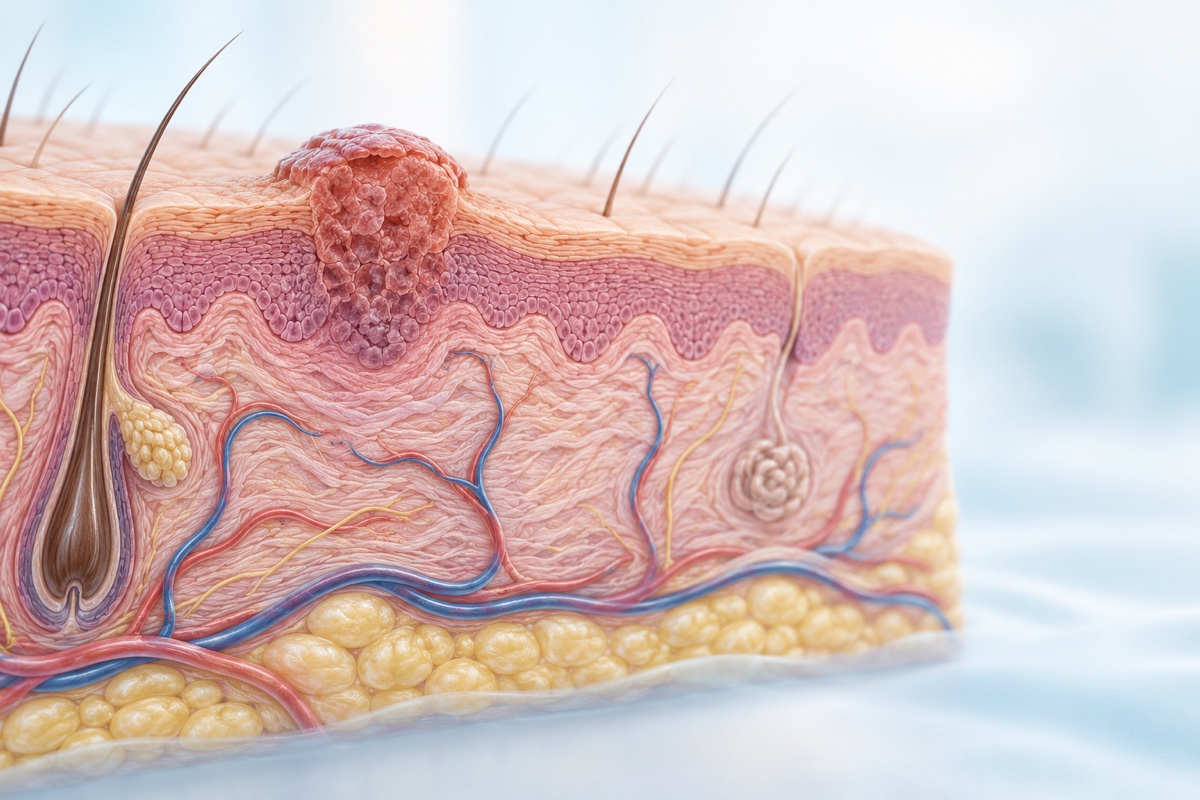
What is non-melanoma skin cancer?
Basal cell carcinoma and cutaneous squamous cell carcinoma are the most common skin cancers and are often grouped as non-melanoma or keratinocyte cancers. Basal cell carcinoma usually grows locally and rarely spreads to distant sites, although neglected or high-risk tumors can damage nearby structures. Squamous cell carcinoma has a greater potential to involve lymph nodes or distant organs, particularly when it has high-risk pathology, arises in certain locations, or occurs in an immunosuppressed person. Long-term ultraviolet exposure and prior sunburns are major risk factors; radiation exposure, chronic wounds or inflammation, arsenic, inherited syndromes, and immune suppression also matter. People of every skin tone can be affected. Actinic keratosis is not invasive cancer but can develop into squamous cell carcinoma. Merkel cell carcinoma and other rare skin cancers are not covered by the usual basal-and-squamous pathway. Follow-up focuses on recurrence and additional skin cancers because a prior diagnosis raises future risk.
Signs and symptoms
A basal cell carcinoma may be a smooth, shiny or pearly bump, a flat scar-like area, or a sore that repeatedly heals and returns. Cutaneous squamous cell carcinoma may appear as a firm red bump, a rough or scaly patch, a crusted or bleeding growth, or a nonhealing sore. Lesions are common on the face, ears, lips, neck, scalp, and hands, but can occur anywhere. New growth, rapid enlargement, pain, numbness, bleeding, or a change within a scar or chronic wound deserves assessment. A lesion near the eye, nose, ear, or lip may affect function even when small. Enlarged nearby lymph nodes can occur with higher-risk disease. These findings can also be caused by noncancer conditions, and appearance varies across skin tones. Diagnosis cannot be made reliably from appearance alone.
Diagnosis and staging
A clinician examines the lesion and surrounding skin, asks about sun exposure, prior cancers, immune suppression, and symptoms, and performs a skin biopsy. The biopsy identifies basal versus squamous cell carcinoma and reports features that help estimate recurrence or spread risk, such as depth, differentiation, and nerve involvement. The clinician also considers size, location, border definition, recurrence, and whether the tumor arose in a high-risk setting. Most basal cell carcinomas and low-risk squamous cell carcinomas do not need extensive imaging. Examination of regional lymph nodes and CT, MRI, ultrasound, PET, or node sampling may be appropriate when a squamous cell carcinoma is high risk or spread is suspected. Staging systems vary by site; some head-and-neck cutaneous cancers use tumor-node-metastasis categories. Margin status after removal helps determine whether more local treatment is needed. Care depends on histologic type, site, stage or risk category, immune status, previous treatment, and patient health.
Established treatment paths
Localized tumors are commonly treated with surgical excision. Mohs micrographic surgery removes tissue in stages while checking margins and is often used for high-risk tumors, recurrences, poorly defined borders, or sites where preserving healthy tissue matters. Selected superficial or low-risk lesions may be treated with curettage and electrodesiccation, cryosurgery, topical medicines, or photodynamic therapy; these approaches are not interchangeable, and choice depends on pathology and location. Radiation therapy can be used when surgery is unsuitable or as additional treatment for selected high-risk features. For basal cell carcinoma that is locally advanced, metastatic, or not amenable to local therapy, hedgehog-pathway targeted drugs or immunotherapy may be considered. Advanced cutaneous squamous cell carcinoma may be treated with PD-1 immunotherapy, with radiation or surgery used in selected settings. Positive margins, recurrence, or spread along a nerve can change the need for additional surgery or radiation. Multidisciplinary review is valuable for complex facial tumors, nerve involvement, nodal disease, or immunosuppressed patients. Treatment depends on cancer type, risk features, extent, prior therapy, immune status, function, and preferences.
Supportive care
Supportive care addresses wound care, pain, infection risk, scarring, and the emotional impact of visible surgery. Reconstructive, dermatologic, ophthalmic, dental, or rehabilitation expertise may be useful when treatment involves the face or affects function. Patients receiving radiation or systemic therapy should report skin changes, fatigue, diarrhea, breathing symptoms, or other new problems promptly. Sun-protective clothing, shade, and broad-spectrum sunscreen reduce additional ultraviolet exposure but do not treat existing cancer. Regular skin examinations and attention to new or changing lesions are important after treatment.
Questions to ask your cancer care team
Use the questions that fit your situation, and add the details that matter most to you.
- Is this basal cell carcinoma, cutaneous squamous cell carcinoma, or another skin cancer subtype?
- Which pathology and location features make this tumor low risk or high risk?
- Would standard excision, Mohs surgery, or another local treatment best balance control and function?
- Do I need lymph-node evaluation, imaging, radiation, or systemic therapy?
- How often should I have skin checks, and which changes should I report promptly?
Clinics for people exploring non-melanoma skin cancer care

Sunridge Medical Center
Sunridge Medical reports treating all advanced cancers. Its published materials specifically name non-melanoma skin cancer care.
Featured placement is separate from an independent ranking or evidence that a clinic is the best fit for a particular patient.Other source-matched clinic profiles
These profiles mention a matching cancer specialty in their published materials. Browse their locations, reported services, and practical details.

Sources
Source information checked: 2026-09-29. The links below identify the public and clinic-provided materials used for this page.
- NCI: Skin Cancer Treatment (Patient Version) ↗Checked 2026-09-29
- NCI: Skin Cancer, Including Melanoma ↗Checked 2026-09-29
- NCI: Skin Cancer Treatment (Health Professional Version) ↗Checked 2026-09-29
How Cancer Clinic Finder compiles information · Suggest a factual correction