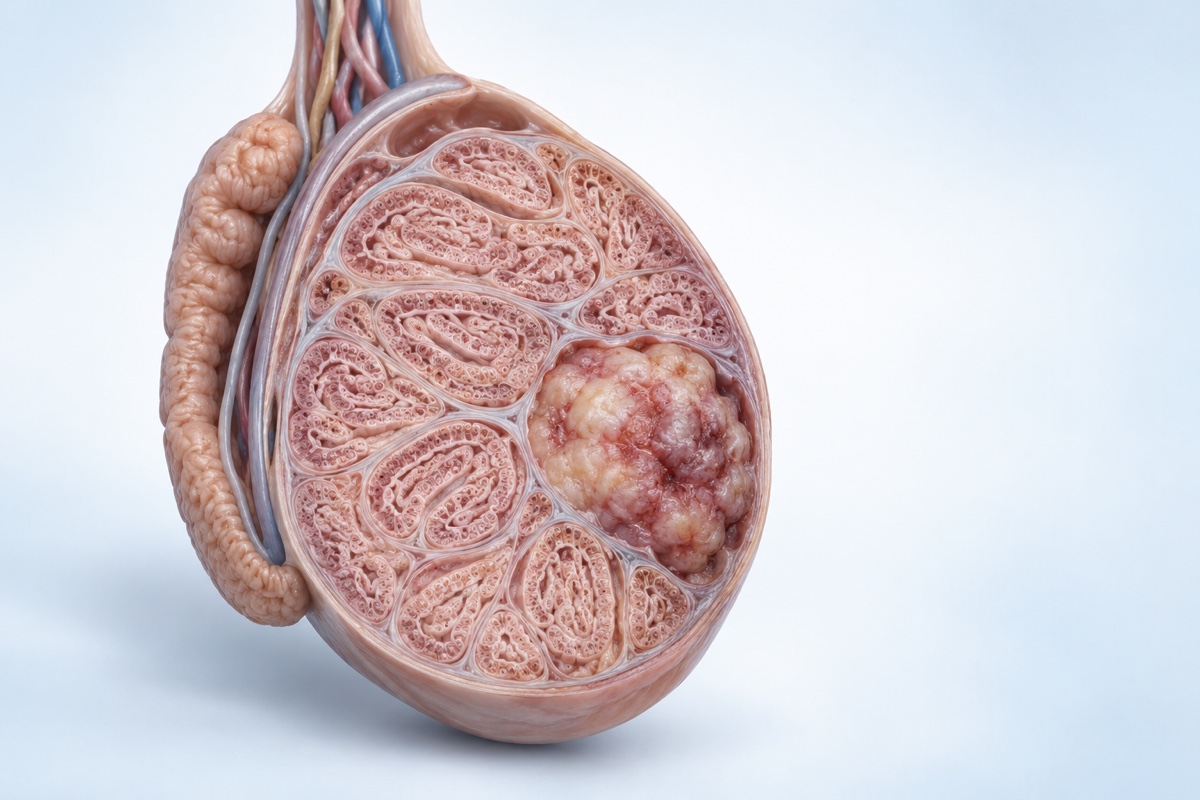
What is testicular cancer?
Most testicular cancers are germ cell tumors and occur in adolescents and younger or middle-aged adults, although other testicular tumors exist. Seminomas and nonseminomas differ in patterns of spread and sensitivity to treatment; mixed tumors are managed as nonseminomas. Risk is higher with an undescended testicle, a personal or close family history, and certain developmental conditions, but many patients have no known risk factor. Disease often spreads first to lymph nodes behind the abdomen and may later involve lungs or other organs. Serum alpha-fetoprotein, beta-human chorionic gonadotropin, and lactate dehydrogenase help establish risk, stage disease, assess response, and detect recurrence. Cancer in the opposite testicle is uncommon but occurs more often after one testicular cancer. Long-term follow-up is essential because surveillance can safely avoid additional treatment for selected early-stage cases only when scheduled examinations, marker tests, and imaging are completed reliably.
Signs and symptoms
A painless lump, enlargement, or change in firmness of one testicle is the most common sign. Other symptoms can include testicular or scrotal discomfort, a heavy feeling in the scrotum, a dull ache in the lower abdomen or groin, sudden fluid collection, or shrinking of a testicle. Hormone-producing tumors may cause breast tenderness or enlargement. Advanced disease can cause back pain, cough, chest symptoms, or swelling, depending on spread. A testicular tumor does not always cause elevated blood markers. Sudden severe testicular pain can signal torsion or another emergency and needs immediate assessment. Lumps and discomfort can also be caused by noncancer conditions such as cysts, infection, injury, hernia, or varicocele. Ultrasound and clinical evaluation are needed to determine the cause.
Diagnosis and staging
Assessment includes examination of both testes and a scrotal ultrasound. Blood is drawn for alpha-fetoprotein, beta-hCG, and LDH before treatment. When imaging suggests a testicular malignancy, the standard diagnostic procedure is radical inguinal orchiectomy, removing the testicle through a groin incision for pathology; cutting through the scrotum for routine biopsy is avoided because it can alter lymphatic spread. Pathology distinguishes seminoma, nonseminoma, mixed germ cell tumor, and other types. CT imaging evaluates retroperitoneal nodes and distant disease, with chest imaging and selective brain or bone imaging as indicated. Markers are repeated after orchiectomy to assess whether they decline as expected. Stage incorporates local extent, lymph nodes, distant metastases, and post-orchiectomy serum markers; metastatic germ cell tumors also use prognostic risk groups. Care depends on histology, stage, marker kinetics, imaging, prior treatment, fertility goals, health, preferences, follow-up reliability, and treatment tolerance.
Established treatment paths
Radical inguinal orchiectomy is the initial treatment and diagnostic step for most suspected testicular germ cell cancers. After surgery, stage I seminoma can often be managed with active surveillance; selected patients receive carboplatin chemotherapy, while radiation has a narrower role because of long-term effects. Stage I nonseminoma options include surveillance, retroperitoneal lymph-node dissection, or short-course chemotherapy based on recurrence risk and patient priorities. More advanced seminoma and nonseminoma are generally treated with cisplatin-based combination chemotherapy, with regimen intensity guided by stage and prognostic group. Surgery may remove residual masses after chemotherapy, especially for nonseminoma, because teratoma and viable cancer may remain. Recurrent disease can require salvage chemotherapy, high-dose chemotherapy with stem-cell support, surgery, or clinical trials. Treatment timing can be urgent when disease is extensive or threatens organ function. Baseline hearing, kidney, lung, and fertility assessment can influence regimen selection and supportive planning. Treatment depends on histology, stage, tumor-marker trends, residual disease, prior therapy, fertility goals, organ function, preferences, and response.
Supportive care
Fertility preservation should be discussed before chemotherapy, radiation, or retroperitoneal surgery; sperm banking is an option for many patients. One remaining healthy testicle often provides enough testosterone, but symptoms of low testosterone warrant testing. A testicular prosthesis can be discussed before or after orchiectomy. Teams monitor nausea, infection risk, hearing, kidney function, lung effects, neuropathy, cardiovascular risk, and emotional or sexual health according to treatment. Long-term survivorship care includes adherence to surveillance and attention to late effects and second cancers.
Questions to ask your cancer care team
Use the questions that fit your situation, and add the details that matter most to you.
- Does pathology show seminoma, nonseminoma, a mixed tumor, or another testicular cancer?
- What stage and prognostic group do my imaging and tumor-marker levels indicate?
- Can I choose surveillance, and what exact visits, blood tests, and scans would it require?
- Should I bank sperm or discuss testosterone and a testicular prosthesis before treatment?
- What short- and long-term effects should I expect from chemotherapy, radiation, or lymph-node surgery?
Clinics for people exploring testicular cancer care

Sunridge Medical Center
Sunridge Medical reports treating all advanced cancers. Its published materials specifically name testicular cancer care.
Featured placement is separate from an independent ranking or evidence that a clinic is the best fit for a particular patient.Other source-matched clinic profiles
These profiles mention a matching cancer specialty in their published materials. Browse their locations, reported services, and practical details.

Sources
Source information checked: 2026-09-29. The links below identify the public and clinic-provided materials used for this page.
- NCI: Testicular Cancer ↗Checked 2026-09-29
- NCI: Testicular Cancer Diagnosis and Prognosis ↗Checked 2026-09-29
- NCI: Testicular Cancer Treatment ↗Checked 2026-09-29
- NCI: Testicular Cancer Treatment by Stage ↗Checked 2026-09-29
How Cancer Clinic Finder compiles information · Suggest a factual correction